


Can Hydrogen's Storage Penalty Be Solved at Ship Scale?
Zero carbon at the point of use, but hydrogen takes up more space than any fuel shipping has ever worked with.
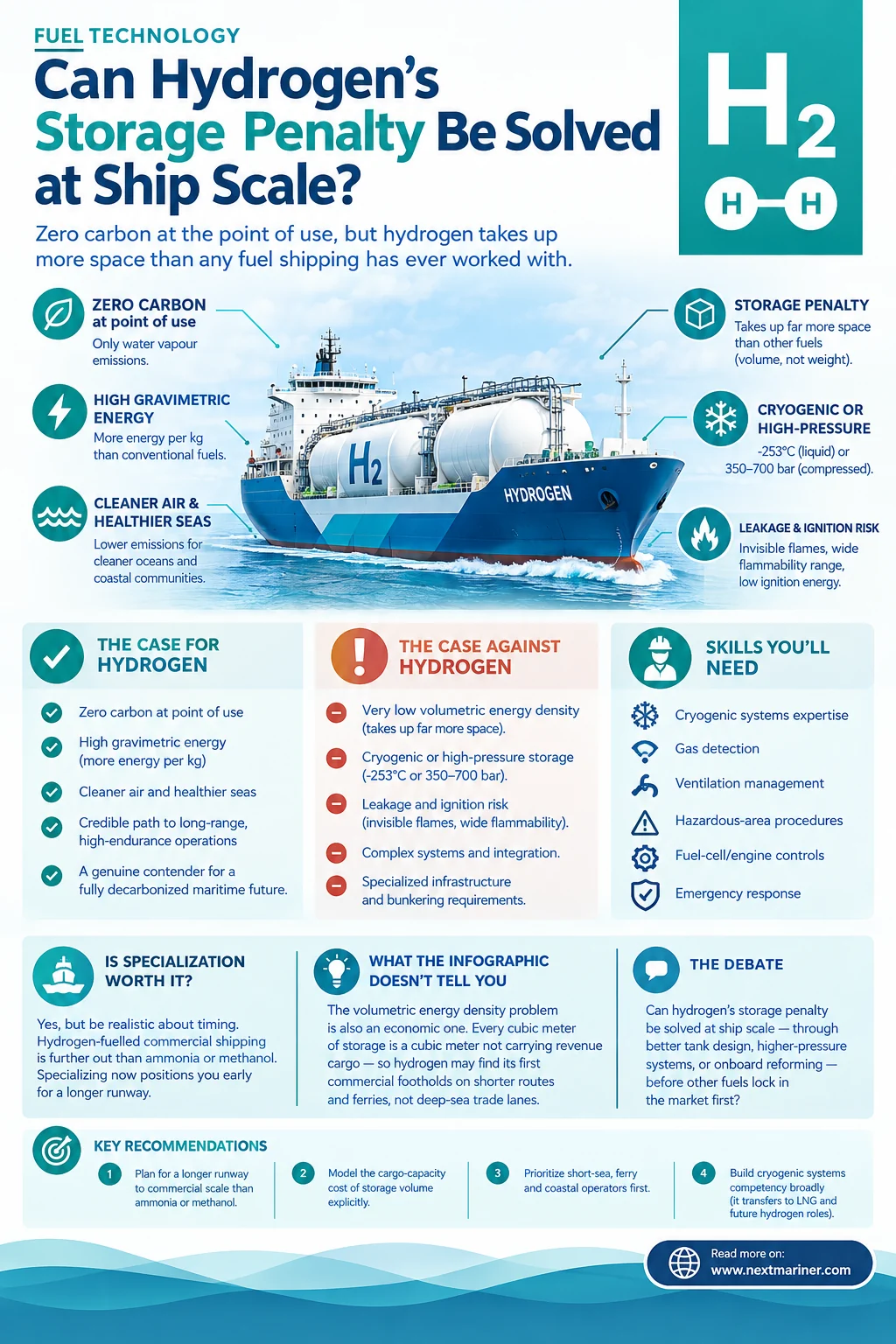
Hydrogen is the fuel with the cleanest exhaust in the entire alternative-fuel conversation — burned or run through a fuel cell, its only emission at point of use is water vapor. It also has the highest energy density by weight of any fuel on this list. The catch is volume, not weight, and it's a catch that reshapes ship design more than any other fuel on this list.
The Case For Hydrogen
Zero carbon at point of use, high gravimetric energy (more energy per kilogram than conventional fuels), cleaner air and healthier seas, and a credible path to long-range, high-endurance operations if the storage problem gets solved. It's a genuine contender for a fully decarbonized maritime future, not just a transitional step.
The Case Against Hydrogen
Hydrogen has very low volumetric energy density — it simply takes up far more space than diesel, LNG, or methanol to deliver the same range, which eats directly into cargo capacity. Storing it requires cryogenic temperatures (-253°C as liquid hydrogen) or extremely high pressure (350–700 bar compressed), both of which demand specialized systems most shipyards have never built at commercial scale. Add invisible-flame leakage risk, a wide flammability range, and low ignition energy, and you have a fuel that's clean to burn but genuinely demanding to store and handle safely.
Skills You'll Need
Cryogenic systems expertise, gas detection, ventilation management, hazardous-area procedures, fuel-cell and engine controls, and emergency response round out the core skill set — several of which barely existed as maritime job descriptions a decade ago.
Is Specialization Worth It?
Yes, but be realistic about timing. Hydrogen-fuelled commercial shipping at meaningful scale is further out than ammonia or methanol. Specializing now means positioning early for a wave that's still forming — a real opportunity for students and early-career engineers willing to bet on a longer runway.
What the Infographic Doesn't Tell You
The volumetric energy density problem isn't just an engineering challenge — it's an economic one. Every cubic meter given to hydrogen storage is a cubic meter not carrying revenue cargo, which changes the business case on shorter, coastal, or ferry routes long before it changes it for deep-sea shipping. Expect hydrogen to find its first commercial footholds there, not on transoceanic trade lanes.
The Debate
Can hydrogen's storage penalty be solved at ship scale — through better tank design, higher-pressure systems, or onboard reforming — before other fuels lock in the market first?
Recommendations:
- Students and early-career engineers interested in hydrogen should expect a longer runway to commercial scale than ammonia or methanol, and plan training accordingly.
- Companies evaluating hydrogen should model the cargo-capacity cost of storage volume explicitly, not just the fuel cost per mile.
- Prioritize hydrogen specialization for short-sea, ferry, and coastal operators first — that's where the economics are likely to work earliest.
- Build cryogenic systems competency broadly; it transfers directly to LNG and future hydrogen roles alike.
Learn & Earn-programmet
Vil du have belønninger og badges for at læse?
Learn & Earn gør læsning til Nautical Miles, badges og rang. Korte lektioner, hurtige quizzer og en gratis konto, der holder styr på hver eneste mil.
Svar
0Vil du være med i hele fællesskabet?
Log ind for at skrive et svar, bakke op om dem du er enig med, og følge dem der skriver dem.