


Can Ammonia Fuel Shipping's Zero-Carbon Future Without Poisoning the Crew Handling It?
Ammonia burns with zero carbon at the point of combustion — but toxicity turns bunkering into a life-safety operation, not a routine one.
Ammonia (NH3) is one of the most-discussed contenders in shipping's fuel transition, and for a simple reason: burned in an engine, it releases zero carbon at the point of combustion. As an established global commodity with existing production, storage, and distribution infrastructure, it looks, on paper, like one of the more scalable options in the race to decarbonize.
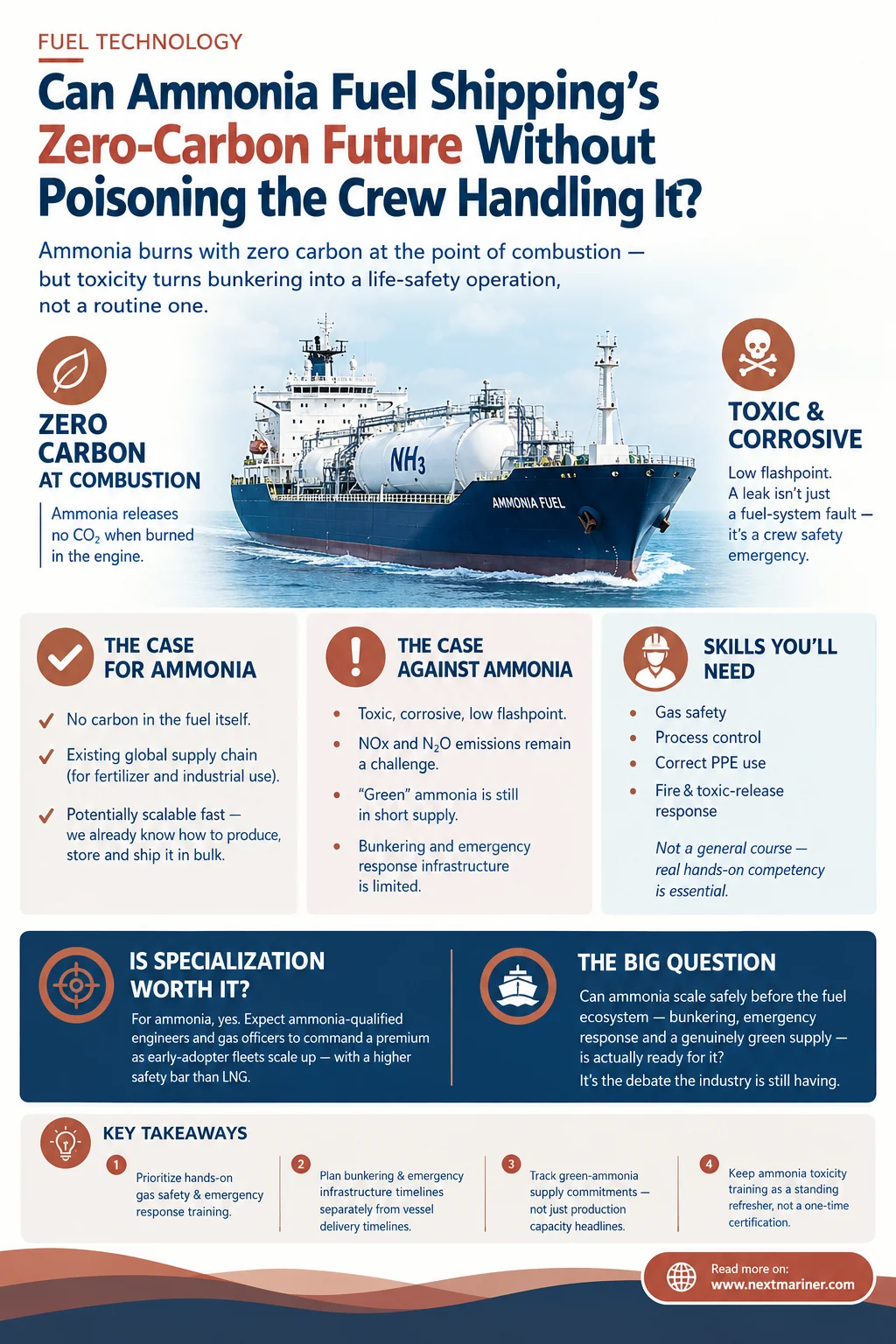
The Case For Ammonia
No carbon in the fuel itself. A mature global supply chain already moves ammonia at scale for fertilizer and industrial use. And unlike some alternatives, it's potentially scalable fast, because the world already knows how to produce, store, and ship it in bulk.
The Case Against Ammonia
The advantages come with a serious catch: ammonia is toxic, corrosive, and has a low flashpoint. A leak isn't just a fuel-system fault — it's a crew safety emergency. Combustion isn't perfectly clean either: NOx and N2O emissions remain a real challenge, and "green" ammonia — made with renewable energy rather than fossil-fuel-derived hydrogen — is still in short supply, which limits how much of ammonia's zero-carbon promise is actually deliverable today.