


Can Hydrogen's Storage Penalty Be Solved at Ship Scale?
Zero carbon at the point of use, but hydrogen takes up more space than any fuel shipping has ever worked with.
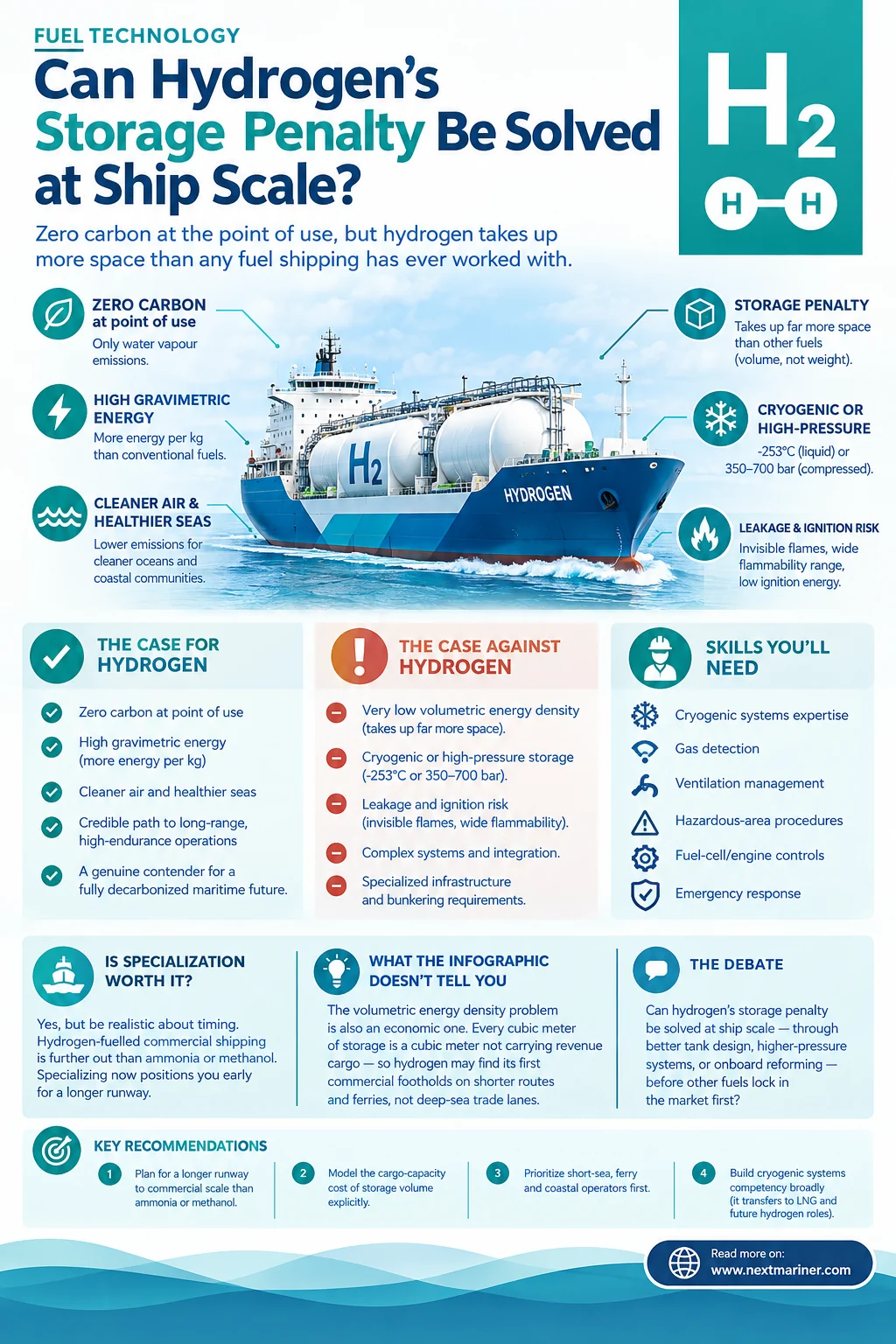
Hydrogen is the fuel with the cleanest exhaust in the entire alternative-fuel conversation — burned or run through a fuel cell, its only emission at point of use is water vapor. It also has the highest energy density by weight of any fuel on this list. The catch is volume, not weight, and it's a catch that reshapes ship design more than any other fuel on this list.
The Case For Hydrogen
Zero carbon at point of use, high gravimetric energy (more energy per kilogram than conventional fuels), cleaner air and healthier seas, and a credible path to long-range, high-endurance operations if the storage problem gets solved. It's a genuine contender for a fully decarbonized maritime future, not just a transitional step.
The Case Against Hydrogen
Hydrogen has very low volumetric energy density — it simply takes up far more space than diesel, LNG, or methanol to deliver the same range, which eats directly into cargo capacity. Storing it requires cryogenic temperatures (-253°C as liquid hydrogen) or extremely high pressure (350–700 bar compressed), both of which demand specialized systems most shipyards have never built at commercial scale. Add invisible-flame leakage risk, a wide flammability range, and low ignition energy, and you have a fuel that's clean to burn but genuinely demanding to store and handle safely.