


Can Ammonia Fuel Shipping's Zero-Carbon Future Without Poisoning the Crew Handling It?
Ammonia burns with zero carbon at the point of combustion — but toxicity turns bunkering into a life-safety operation, not a routine one.
Ammonia (NH3) is one of the most-discussed contenders in shipping's fuel transition, and for a simple reason: burned in an engine, it releases zero carbon at the point of combustion. As an established global commodity with existing production, storage, and distribution infrastructure, it looks, on paper, like one of the more scalable options in the race to decarbonize.
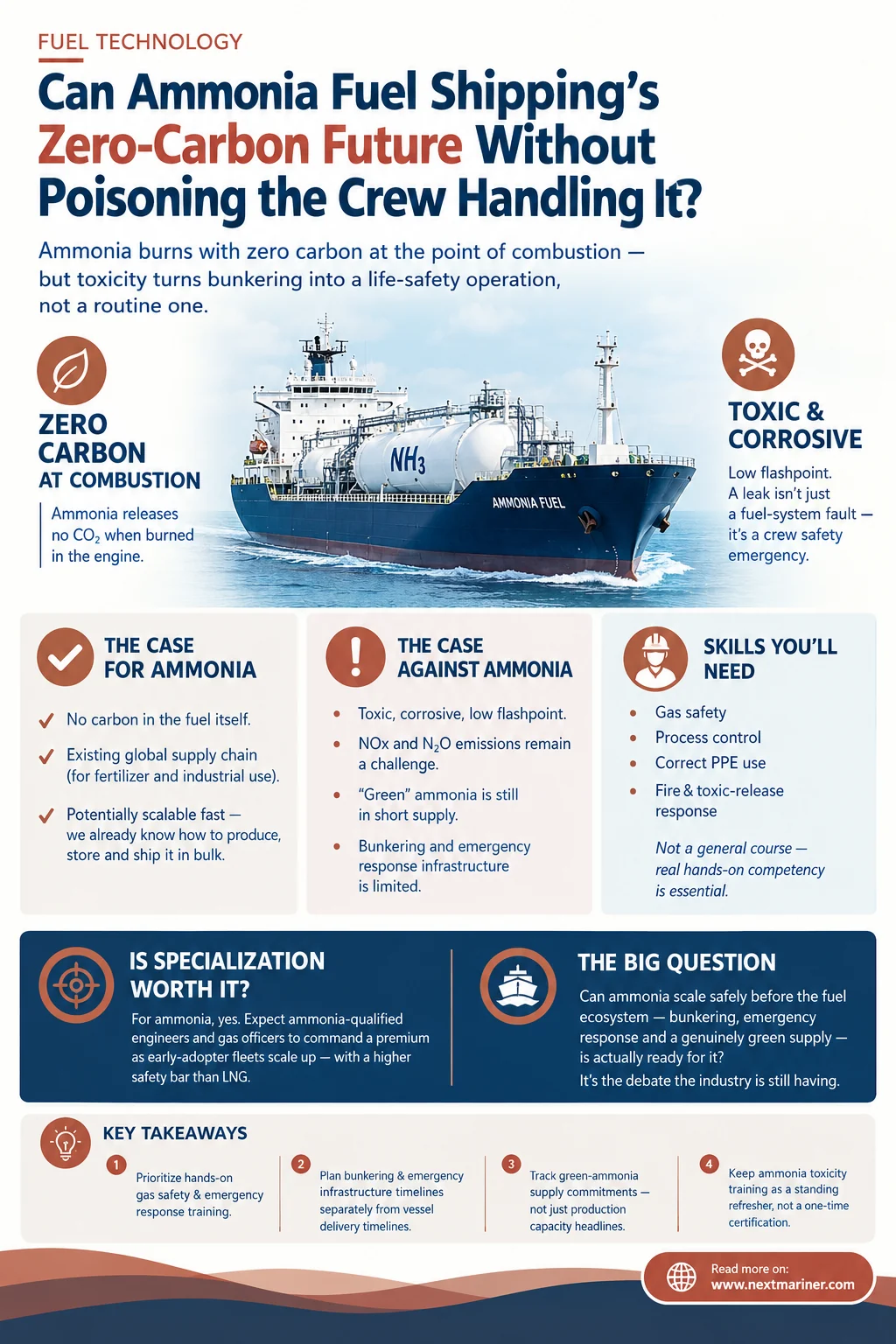
The Case For Ammonia
No carbon in the fuel itself. A mature global supply chain already moves ammonia at scale for fertilizer and industrial use. And unlike some alternatives, it's potentially scalable fast, because the world already knows how to produce, store, and ship it in bulk.
The Case Against Ammonia
The advantages come with a serious catch: ammonia is toxic, corrosive, and has a low flashpoint. A leak isn't just a fuel-system fault — it's a crew safety emergency. Combustion isn't perfectly clean either: NOx and N2O emissions remain a real challenge, and "green" ammonia — made with renewable energy rather than fossil-fuel-derived hydrogen — is still in short supply, which limits how much of ammonia's zero-carbon promise is actually deliverable today.
Skills You'll Need
Crews and shore staff working with ammonia-fuelled vessels need genuine specialization in gas safety, process control, correct PPE use, and fire and toxic-release response — not a general familiarization course, but hands-on competency, because the margin for error with a toxic gas is much smaller than with a flammable-only fuel.
Is Specialization Worth It?
For ammonia specifically, yes. This is not a fuel where a generalist, "I've done an online module" level of training is defensible. Expect ammonia-qualified engineers and gas officers to command a premium as early-adopter fleets scale up, similar to how LNG specialists did a decade ago — but with an even higher safety bar attached to the qualification.
What the Infographic Doesn't Tell You
Bunkering infrastructure for ammonia is still sparse outside a handful of pilot ports, and port authorities are still working through emergency response planning for a toxic fuel at scale — that's a slower build-out than the technology itself. Insurance and classification frameworks are evolving in real time alongside the first ammonia-fuelled newbuilds, which means early-adopter companies are effectively writing the safety playbook as they go, not following an established one.
The Debate
Can ammonia scale safely before the fuel ecosystem — bunkering, emergency response, and a genuinely green supply — is actually ready for it? That's the open question the industry is still arguing about, and it's worth having a view on if you're planning a career around this fuel.
Recommendations:
- If you're pursuing ammonia specialization, prioritize hands-on gas safety and emergency response training over classroom-only familiarization.
- Companies investing in ammonia-fuelled newbuilds should budget for bunkering and emergency-response infrastructure timelines separately from the vessel delivery timeline — they rarely move at the same pace.
- Track green-ammonia supply commitments, not just production capacity headlines, before counting on the zero-carbon claim holding up at scale.
- Treat ammonia toxicity training as a standing refresher, not a one-time certification.
Learn & Earn
Want rewards and badges for reading?
Learn & Earn turns reading into Nautical Miles, badges and rank. Short lessons, quick quizzes, and a free account that keeps every mile you earn.
Responses
0Want to interact with an entire community?
Sign in to add a response, back the ones you agree with, and follow the people writing them.