


Can Nuclear Propulsion Finally Earn a Place in Commercial Shipping?
Extremely high energy density and near-zero operational emissions — if the industry can solve safety, regulation, and public perception at once.
Nuclear marine propulsion isn't new — navies have run reactors at sea for decades — but commercial shipping has never adopted it at scale. Renewed interest in decarbonization has put it back on the table, and it remains the most technically compelling and most institutionally complicated option on this list.
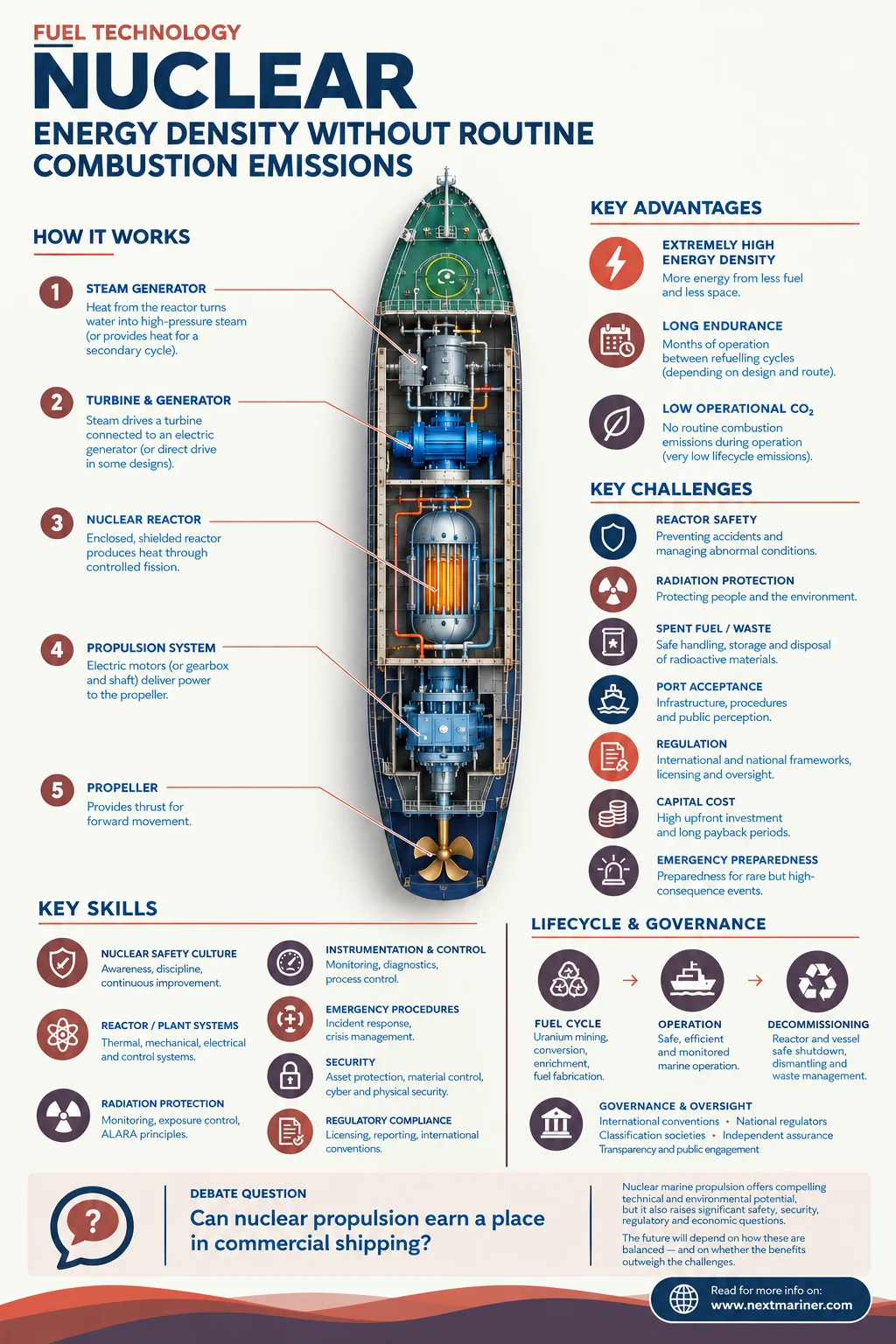
How It Works
Heat from a controlled fission reaction turns water into high-pressure steam (or provides heat via a secondary cycle), which drives a turbine connected to a generator or direct-drive propulsion, ultimately turning the propeller. It's mechanically similar to conventional steam propulsion — the difference is entirely in how the heat is generated.
The Case For Nuclear
Extremely high energy density delivers far more energy from less fuel and less space than any other option on this list. Long endurance allows months of operation between refuelling, depending on design and route. And operational CO2 is very low — no routine combustion emissions during normal operation, with very low lifecycle emissions overall.
The Case Against Nuclear
The challenge list is long and serious: reactor safety and preventing abnormal conditions; radiation protection for people and the environment; safe handling, storage, and disposal of spent fuel and radioactive waste; port acceptance, covering infrastructure, procedures, and public perception; complex international and national regulatory frameworks, licensing, and oversight; high capital cost with long payback periods; and emergency preparedness for rare but high-consequence events.
Skills You'll Need
This is a genuinely different career track, not an add-on certification: nuclear safety culture and continuous vigilance, reactor and plant systems design and operation, radiation protection and dosimetry, instrumentation and control, emergency procedures and crisis management, physical and cyber security for nuclear assets, and regulatory compliance and reporting.
Is Specialization Worth It?
If commercial nuclear shipping scales, this will be one of the highest-value, most specialized career tracks the industry has ever created — but it's a genuine long-term bet, closer in spirit to a nuclear engineering career than a typical seafaring one, and the timeline to meaningful commercial scale remains uncertain.
What the Infographic Doesn't Tell You
The full lifecycle and governance chain — from fuel cycle (uranium mining, conversion, enrichment, fabrication) through operation to decommissioning — involves international conventions, national regulators, classification societies, independent assurance, and public engagement at every stage. That governance complexity, more than the engineering itself, is likely the real bottleneck standing between nuclear propulsion and commercial adoption.
The Debate
Can nuclear propulsion earn a genuine place in commercial shipping — and if so, is the industry's hesitation really about the technology, or about public trust and regulatory readiness catching up to it?
Recommendations:
- Treat nuclear marine careers as their own specialized track, closer to nuclear engineering than conventional seafaring, if you're considering this path.
- Companies exploring nuclear propulsion should budget for regulatory and public-engagement timelines as seriously as engineering ones — they may be the longer pole.
- Watch port infrastructure and acceptance developments closely; they'll likely signal commercial viability before the technology itself does.
- Don't underestimate decommissioning and waste management planning — it's part of the real lifecycle cost, not an afterthought.
Learn & Earn
Want rewards and badges for reading?
Learn & Earn turns reading into Nautical Miles, badges and rank. Short lessons, quick quizzes, and a free account that keeps every mile you earn.
Responses
0Want to interact with an entire community?
Sign in to add a response, back the ones you agree with, and follow the people writing them.